单例模式可能是大家最为熟知的一种设计模式,本身没什么好谈的。但是在 C++ 中,由单例模式可以引出一系列的问题,可能会比较有意思,这里探讨一下。
常见的简单实现
1.使用 static 实现
1
2
3
4
5
6
7
8
9
10
11
12
13
14
15
16
17
18
19
20
21
22
23
24
25
26
27
class S1 { public : static S1& GetInstance () static S1 s; return s; } void fun () private : S1 (){cout<<"S1 inited" <<endl;} S1 (const S1&) = delete ; S1& operator =(const S1&) = delete ; }; class S2 { public : static S2& GetInstance () return s; } void fun () private : S2 (){cout<<"S2 inited" <<endl;} private : static S2 s; }; S2 S2::s;
其中 S2 是要避免的。因为 1. 类的静态成员变量的初始化时间一般早于 main 函数 2. 如果静态成员的初始化里调用了其它类,可能出现未定义的错误。
2.使用指针判断是否初始化
1
2
3
4
5
6
7
8
9
10
11
12
class S3 { public : static S3& GetInstance () if (s == 0 ) s = new S3 (); return *s; } private : S3 (){} static S3 *s; };
这两种方式在单线程程序中使用都是可以的,但如果在多线程中,就会出现问题。
Magic Static
对于 S1 要注意, C++ 局部静态变量的初始化可能不是线程安全的 , 这就是 Magic Static ,是指 返回一个静态局部变量的引用 的用法,在某些情况下,如S1 可能会被编译器这样解析:
1 2 3 4 5 6 7 8 9 10 static S1& GetInstance () static bool constructed = false ; static uninited S1 s; if (!constructed){ constructed = true ; new (&s)S1; } return s; }
这不是线程安全的。这里的 “某些情况” 是指 C++11之前的编译器。尽管C++11 标准规定这个过程应该是线程安全的,但是在 VS2015 之前,微软还是未实现这个标准。参见这里 Thread-Safe “Magic” Statics Static local variables are now initialized in a thread-safe way, eliminating the need for manual synchronization. Only initialization is thread-safe, use of static local variables by multiple threads must still be manually synchronized. The thread-safe statics feature can be disabled by using the /Zc:threadSafeInit- flag to avoid taking a dependency on the CRT. (C++11) 这里 和 这里
Double-Checked Locking Problem
对于 S3, 在多线程中, “s==0” 这个条件可能会被多个线程判断为 true, 这会导致 s 被多次初始化, 而只有最后一次初始化有效, 那么对其改进如下:
1
2
3
4
5
6
static S3& GetInstance () Lock lock; if (s == 0 ) s = new S3 (); return *s; }
这是线程安全的,但引出的问题是,每次都会调用该方法都要加解一次锁,加解锁的过程是很耗资源的。那么对于上面的代码可以有如下改进:
1
2
3
4
5
6
7
8
static S3& GetInstance () if (s == 0 ){ Lock lock; if (s == 0 ) s = new S3 (); } return *s; }
这段代码解决了每次调用都要加解锁问题。但它仍然不是线程安全的。编译器可能会将代码解析成这样:
1
2
3
4
5
6
7
8
9
10
11
static S3& GetInstance () if (s == 0 ){ Lock lock; if (s == 0 ){ S3* tmp = operator new (sizeof (S3)); tmp = new (s) S3; s = tmp; } } return *s; }
但也可能解析成这样:
1
2
3
4
5
6
7
8
9
10
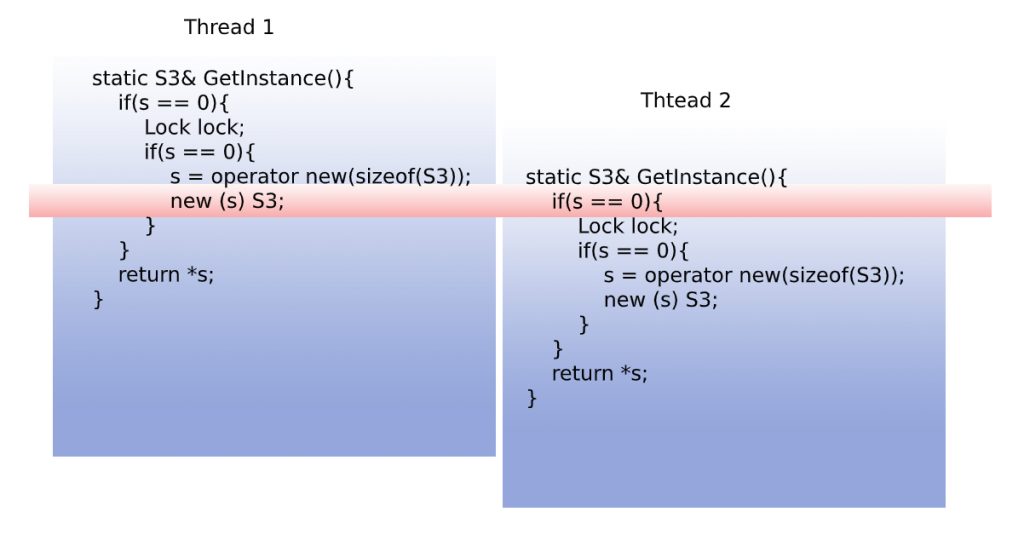
static S3& GetInstance () if (s == 0 ){ Lock lock; if (s == 0 ){ s = operator new (sizeof (S3)); new (s) S3; } } return *s; }
对于后一种情况,它将先为 s 分配一段内存,再将为它构建对象: 它不是线程安全的。
如图,当线程1为 s分配内存后,线程2 判断 s==0 为flase, 此时线程2 将返回一个已分配内存但未初始化的指针, 可能会引起程序崩溃。
volatile
在网上有很多帖子认为使用 volatile 可以解决 DCLP , 实际情况是, 使用 volatile 无法完美解决这个问题。这个我们下一节再作讨论。
基于 C++11 的解决方案
C++11 为我们提供了很多方便好用的同步原语,可以帮助我们解决前面提到的问题。
atomic
将变量声明为原子的,可以确保双检锁正确执行:
1
2
3
4
5
6
7
8
9
10
11
12
13
14
15
16
17
18
19
20
21
22
23
class S3 { public : static S3& GetInstance () if (s == 0 ) { std::lock_guard<std::mutex> locker (mu) ; if (s == 0 ) { s = new S3 (); } } return *s; } void fun () "aa" << endl; } private : S3 (){}; static std::mutex mu; static std::atomic<S3*> s; }; std::mutex S3::mu; std::atomic<S3*> S3::s = 0 ;
callonce
使用 callonce /onceflag 则是一种更优雅的方式:
1
2
3
4
5
6
7
8
9
10
11
12
13
14
15
16
17
18
19
class S3 { public : static S3& GetInstance () std::call_once (flag_, []() { s = new S3 (); }); return *s; } void fun () private : S3 () = default ; private : static S3* s; static std::once_flag flag_; }; S3* S3::s; std::once_flag S3::flag_;
使用模板的单例模式
更多的时候, 我们是仅定义一个单例模式的基类, 使需要使用单例的类来继承这个基类。定义如下:
1
2
3
4
5
6
7
8
9
10
11
12
13
14
15
16
17
18
19
20
21
22
23
24
25
26
27
28
29
30
31
32
33
34
35
36
template <class T >class SingletonBase { public : static T* GetInstance () std::call_once (flag_, [&]() { ins_.reset (new T); }); return ins_.get (); } virtual ~SingletonBase <T>() = default ; protected : SingletonBase <T>() = default ; SingletonBase <T>(const SingletonBase<T>&) = delete ; SingletonBase<T>& operator =(const SingletonBase<T>&) = delete ; protected : static std::unique_ptr<T> ins_; static std::once_flag flag_; }; template <class T >std::unique_ptr<T> SingletonBase<T>::ins_; template <class T >std::once_flag SingletonBase<T>::flag_; class S3 : public SingletonBase<S3> { friend class SingletonBase <S3>; public : void fun () ~S3 () = default ; private : S3 () {} };
多参数构造函数的单例模式
1
2
3
4
5
6
7
8
9
10
11
12
13
14
15
16
17
18
19
20
21
22
23
24
25
26
27
28
29
30
31
32
33
34
35
36
37
38
39
40
41
42
43
44
45
46
47
48
49
50
51
52
53
54
55
56
57
58
59
60
61
62
template <class T >class SingletonBase { public : template <class ... Args> static T* GetInstance (Args&&... args) std::call_once (flag_, [&]() { ins_.reset (new T (std::forward<Args...>((args)...))); }); return ins_.get (); } static T* GetInstance () if (!ins_) throw std::logic_error ("please init class first" ); return ins_.get (); } virtual ~SingletonBase <T>() = default ; protected : SingletonBase <T>() = default ; SingletonBase <T>(const SingletonBase<T>&) = delete ; SingletonBase<T>& operator =(const SingletonBase<T>&) = delete ; protected : static std::unique_ptr<T> ins_; static std::once_flag flag_; }; template <class T >std::unique_ptr<T> SingletonBase<T>::ins_; template <class T >std::once_flag SingletonBase<T>::flag_; class S3 : public SingletonBase<S3> { friend class SingletonBase <S3>; public : void fun () ~S3 () = default ; private : S3 () {} }; class S4 : public SingletonBase<S4> { friend class SingletonBase <S4>; public : void fun () private : S4 (const int && n) : size_ (n) {} private : int size_; }; int main () S3::GetInstance ()->fun (); S4::GetInstance (1 )->fun (); S4::GetInstance ()->fun (); return 0 ; }
此时必须注意,需要和无参数的单例模式分开来。